Monday, November 4, 2013

What is a boda boda?


This is a taxi stand.
 It may not look like what you are expecting, but for a Kampala resident, the boda boda is the cheapest and most common type of taxi.These mini taxis cluster on the street corners where the drivers spend their time chatting and socializing.  Some of the larger stands also seem to function as garages, where mechanical drivers tune up and repair their bikes.

If you want to get around the city, you can always walk.  Many people walk long distances every day. But Kampala is a bustling capital city with many hills, and motorized transport is much in demand.  There are the ever present Toyota mini vans, called Matatos, but a more personal, though seemingly more dangerous alternative, is the boda boda.

Boda bodas are everywhere.  They weave between lanes of traffic, creating their own narrow paths between blocked cars and trucks.  They have no respect for traffic lights, and only stop to unload their passengers. The audacious drivers speed their riders to their destinations, with great skill.  


The boda boda is a motorcycle specifically adapted for passengers.  Behind the driver is a wide bench, with hand holds for the brave riders.  Most of the time it is a single person, but often two passengers squeeze together on the seat behind the driver.  The passengers are often women with packages to carry. Sometimes it is a man in a suit, carrying a brief case.  Only once have I seen a  white man riding like this.

Once I saw a smartly dressed woman slide off her boda boda perch, rest her handbag on the seat, pull out a pair of white high heels, and slip them on her feet.  Then she slipped the sandals into her bag, and headed for the cathedral entrance.  

Another time I noticed little feet peeking out as a mother rode, carrying her small child in her lap.
The drivers often wear helmets, but I have rarely seen a passenger so equipped. I have also not seen an accident, but I have no doubt that they occur.  This is a place where even crossing the street is risky.  


Since they go everywhere boda bodas can be a nuisance.  When we went to the Ndere Cultural Center, we saw the following sign. "No boda bodas beyond this point."  But these cycles are ubiquitous.  And everyone depends on them.

Dance. Dance, Dance

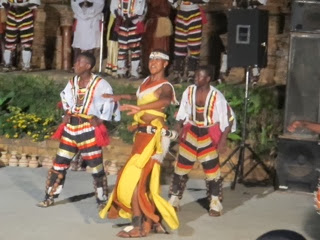
It was dinner and a show last night at the Ndere Cultural Center. And we witnessed some spectacular dancing, accompanied by a wide array of traditional instruments.  There were many styles and shapes of drum, stringed instruments, and pipes.  The event took place in a large open air amphitheater with seating at tables.
Uganda is home to several different tribes, each with different styles of dress, dance, and instrument.  The very funny MC kept us laughing as one tribal tradition after another strutted their stuff on the multi level stage.
. There was a lot of hip wiggling, mostly by the women.  
But these gyrations made the dances at the UCU graduation look tame.  
There was a dance in which the girls escaped from the boys in great leaping runs.  There was a "hug" which looked more like wrestling.  
There were enormous drums held on the head to play.  
The dancers glistened with sweat as they jumped and turned. The songs were haunting. And it was easy to imagine these dances around a village fire.
.  It was hard to tear ourselves away long enough to serve ourselves at the barbecue buffet.  The final dance featured clay pots which had been sitting innocently at the back of the stage.  The girls piled one clay pot after another on their heads until each was balancing a tower as tall as the dancer.
  Not a single pot fell.  It was a late night but an unforgettable experience.

Sunday, November 3, 2013

Safari Massage

Today we sit by the hotel pool waiting for the solar eclipse, which will be total just north of Kampala.  With a pinhole and a sheet of paper we succeeded in projecting the image on a pillar outside our hotel. It's not as good as the image on TV but it was exciting to experience.

Yesterday we ventured into the countryside for a day of adventure.  We packed into a small bus and headed east on the road to Kenya.  As we left Mukono we began to see a rural view with hillsides of tea plantations and acres of sugar cane. Flowered trees and coconut palms sped past the window.

There were also many buildings.  Rows of stores display clothes, furniture, building materials, food, telephones and airtime.  Banks offer micro loans, and all kinds of schools compete for students.  Churches and mosques occasionally face each other across the road. We stopped briefly at a roadside fruit market to buy fresh bananas.  
Our road passed through Mabira Forest a cool region of shadowy woods.  As we crossed the Nile River bridge we refrained from photographing the impressive dam to avoid a confrontation with the soldiers stationed by the sign. 

From there our route went deep into the country to visit the site of the martyrdom of Bishop Hannington who died in 1885.  As we turned off the main road we saw many small compounds with two to four round grass covered huts. Children chased the bus to see what we might offer them.  
Finally we came to a church where we met the priest who serves the people of the area.  He joined us for a ride up the steep hill to the spot where Bishop Hannington lived when he came to the region.  
At the top of the hillside was an impressive group of granite boulders.  He told us the story as he led us between the rocks.

Apparently the Bishop lived there and preached to the surrounding population from a large granite platform.  
As they gathered to listen to him about 50 were converted to Christianity.  When the local Buganda king, the Kabaka, heard of this preacher, he sent his soldiers to kill the Bishop.  Hannington was tortured and killed at a place which they call the Martyrs' Stone.
Of the 50 followers, 48 were also killed.  The two who escaped, buried the Bishop's body, and told the story. 

The view from the top of the hill was spectacular.  The whole vista of the countryside was before us, with a clear but distant view of Lake Victoria where we headed for lunch.
After reaching Jinja we recrossed the Nile.  There off the road was a small resort with a pool, restaurant and sleeping huts.  Since we were starved, we fell on the buffet lunch with enthusiasm, then crossed the lawn to reach the small wooden boats on the edge of the lake.  The lake, of course, was Lake Victoria, the largest of the lakes in the Rift Valley, bordered by Uganda, Kenya, and Tanzania.

Our guide motored us out into Lake Victoria.  Many different species of birds perched on the edges of the fish farms.  

Small wooden fishing boats hunted in the rich waters of the lake. Victoria is very deep, like many of the Rift Valley lakes.  And it is rich in fish, especially Tilapia.  

And then we headed to the source of the great Nile River. The Nile is not the longest in the world (that is the Amazon).  But it is the only major river in the world that flows north.  
As the river leaves the lake the water swirls as the current gathers speed.  Originally there had been a set of falls as the water from the lake fell into the river, but the dam we had crossed down river changed the flow.  Now it is harder to see the source, but still visible at the water surface.  

The ride home was our Safari massage.  Much of the road was either unpaved, or felt that way.  Great clouds of ochre dust swirled through the windows, coating our hair, mouth and lungs with red particles.  We bounced along through lines of traffic, finally arriving at our hotel, tired, hungry, and very dirty.  

Friday, November 1, 2013

Graduation Ugandan Style


Today we attended the graduation ceremony at Uganda Christian University.  We have never seen such an exuberant, joyful, elaborate affair.  We arrived at about 9:30 and ushered to the VIP seating.  From there we had a great view of the series of white tents set up in a U shape, leaving the center space for performances, entrances and exits.  


This was a day for the "Mamas."  The fathers were there but the exuberant displays was from the Mamas.  They were adorned with several styles of traditional dress,most frequently the Gomesi, which originated in the 19th century when a tailor named Gomez was asked to design a uniform for a girls' school.  The original design has probably,y evolved so much as to be unidentifiable by the original tailor, but it seems that every lady of a certain age has one.  These dresses are brilliantly colored with enormous sashes, tied in a huge knot at the waist. They seem to look best when the wearer is plump, and they demand attention.  They came in every size and color imaginable, and i couldn't stop staring.

The entertainment included a lot of drumming and a fantastic dance in which the girls wiggled their feathered hips so fast, they almost blurred  The drummers were in the center and eight dancing girls spread out to give the audience a great view.

The sun shone brightly on the conical tents draped in lavender and pink.  The graduates took their seats wearing black robes and mortarboard hats, but adorned with elaborate colored hoods which corresponded in size and hue to their field of study and degraa.  The colorful hoods gave us a clue to what was on the way.  The marching band struck up the national anthem and lead the faculty and administration up to the front podium.  The faculty were even more colorful than the graduates.  American professors would be jealous of this brilliant academic plumage.  After the national anthem, everyone sang a hymn.


There were several speeches, mostly short.  The main speech was by an American, Dr. Graham Walker, the President of Patrick Henry College in Virginia. The speeches stressed moral values and Christian faith and commitment.  UCU takes their Christianity very seriously. Although not all students are Christians, and some of the graduates were Muslim, the school does not try to downplay their faith.  They make it a centerpiece of the character development that brings them more students than their rival university in Uganda. They graduated 1668 students today.


The most exciting part of the ceremony was the reaction of the Mamas when their child's name was read.  As soon as they heard the name they jumped up in their seats, or found their way to the aisles. They raised both hands and began to shriek and ululate in high pitched voices.  Those in the aisles would leap and whoop with great joy. It seemed like a competition, and you never knew where it would erupt next.

Afterward, I talked with one of the professors who told me that many of these ululating Mamas were illiterate   themselves and had sacrificed much to pay for their children's schooling. Their extreme joy represents the extreme sacrifice and great pride they feel in the achievement of their children.
The Dean of the Department of Education and Arts, Dr. Medard Rugyiendo with his friend, Bishop.  
Groundbreaking for the new Student Center which will be designed by Michael Reid, Waring Class of '86, shown here with his wife Kris.


Thursday, October 31, 2013

Monkeys All Around

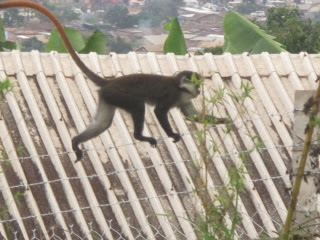
In Boston, when we host our French guests, they are delighted by the squirrels running around Boston Commons. Here there are no squirrels but in the morning and late afternoon, the monkeys put on a show. Like squirrels, they scurry and jump, but their jumping leave the squirrel displays in the dust. They love to swing from tree to tree.  They swing out on a hanging branch and swing in a long arc to the next tree.  Then three or four of their friends follow.  They balance on a fence, keeping upright by sheer speed and the length of their tales. Occasionally they fall but it doesn't seem to matter. Up they go again, chasing and climbing till they tire and find a spot high up to rest.

Wednesday, October 30, 2013

An Awesome Library

  We arrived at Uganda Christian University yesterday.  I will write more about the school later.  But first I want to share our visit to the new library building. The Hamu Mukasa Library is the largest building on campus, and it was designed by Michael Reid, Waring class of '86.  
Michael gave us an architect's tour of the building yesterday afternoon, and we were all blown away by the beauty, ingenuity, and skill of his work.  
Because of the cost of running air conditioning for a building this size, Michael designed a climate controlled building, which depends on natural airflow for circulation and climate control. There are louvres to provide light but block the sun's heat.  
The books are dispersed in modules rather then concentrating them in the same spot.  
There are open shafts that allow air to move throughout the different floors.  
Only the room where the servers are stored and the computer lab are air conditioned.

Michael chose building materials which were available in Uganda.  The bricks are made with the local red clay.  Since steel is not produced in Uganda the structure is concrete and the walls are made of reinforced board form concrete.  He used wood planks in the ceilings to damp the sound and provide visual interest.  
There are also woven bamboo panels on some ceilings to dampen the sound.  The books themselves absorb sound.  

The library is large and students fill the reading rooms.  The study tables are covered with books.  
The computers are running design software.  
Students make good use of computers throuout the building. When I asked them about the library buildings students said they love it.
 The building came in significantly under budget and on time. The new library opened in 2011 and cost 4.1 million rather than the projected 5 million.  

Michael's next project is a new student union building with facilities that encourage the social life of the 8000 students at this campus.  He loves it here and looks forward to creating another signature building at UCU.  Congratulations to this outstanding Waring alum.
Dr John Senyonyi, Vice Chancellor, (President) of UCU and two of the library directors.