Saturday, May 31, 2014

On the Road


Friday morning dawned clear, and a glance out our bedroom window revealed a bright blue sky and a mighty white peak.
No cloud marred the view.  I took photos before breakfast and several times before we packed the car,  just to compare our view with the postcards in the gift shop.  We watched as about 30 hikers lined up with impressive gear, ready to scale the heights.  
As we left we decided to drive by Reflection Lake to see if we could duplicate that postcard. Alas, the lake was buried in snow, but the mountain was just as lovely.

We drove out of the park, glancing back from time to time to glimpse the peak over the farm fields until we turned our sights northwest to the Olympic Peninsula. We followed Rt 101 which winds around the coastline.  It was a beautiful drive. We stopped from time to time, and picnicked along the way.
We glimpsed the huge series of snowy peaks, not as high as Rainier but more massive and compact.  The signs pointed us to Port Angeles, which is a port for several cruise lines. We saw the large ships at berth in the port, but our goal was the Olympic National Park.  
We wound past Crescent Lake on our way to the Sol Duk Hot Springs Lodge.  As we turned down the road and followed the Sol Duk River, the trees soared on either side. It felt like we were driving through a city block lined with tree skyscrapers.  

The lodge was relaxed and welcoming. We checked into our little cabin, and went for an informal dinner.
Then we pulled on our swimming suits and went for a relaxing soak.  An hour in the medium pool and we were ready for a good night's sleep. The beds were wonderful.

The Miracle in the Sky


The weather the next morning was just as bad.  Snow had fallen overnight. But we had slept well and the breakfast buffet was sumptuous.  We were glad that we knew how to layer our clothes.  We filled our backpacks with sweaters, jackets and fleece and headed for the Grove of the Patriarchs.  The rain had stopped, but the air was cold and a thick layer of clouds stretched across the sky.  We stopped at one spot that proclaimed itself to be the best view of the mountain.  The view was a solid bank of gray.

We found the trailhead leading to the Grove of the Patriarchs.  They are 1000 year old trees, Douglas Firs that reach up for 200ft.  As we entered the forest, it was the profusion of green that amazed me. There was lichen and moss, ferns and grass, fir and balsam with tiny pink or white or yellow flowers like dots on the green.
 The Ohanapecosh River flowed along our path and murmured gently as we walked. It is a river flowing from an inactive glacier so its water is clear and turquoise blue.  
We reveled in the small leaves, the enormous trees, the smell,of pine and the smiling water.  
When we got back to the car our mood had lifted, and we were feeling less discouraged by the weather.
We drove to the Ohanapecosh campground where we found a picnic table and made a meal from the groceries we had picked up the day before.  Then we followed the trail through the hot springs there.  We knelt down to feel the warm water flow over our fingers.  It was an easy, quiet stroll.
Our next stop was a trail that lead to a place called Silver Springs. The trail followed the Ohanapecosh River as it descended.
The forest was similar but the trees were smaller.  
The trail was higher, but we could still hear the river on our left.  As we continued the trail began to drop, and we could see white water down below.  Finally we came to a bridge which crossed the river at a rocky shelf. A mass of splintered logs lay beneath the flow as the river crashed down on the rocks.
The sun dappled the forest as we hiked back to our car. We didn't realize it until we drove along and looked up to see a wall of snow covering the sky. Is it possible?  Are we looking at Mount Rainier?
 
Yes, without a doubt that is the grand lady herself.  We drove to the spot where we had seen only a mass of gray earlier in the morning. We sat on the wall for a long time watching the shy lady peeking out from her veil of clouds. 
Finally we looked down to see a magnificent falls pouring down below, and we decided to explore further.  This was Narada Falls, a drop of 160 feet.  We looked at it from above for a while until we noticed a spot at the base with what seemed like the end of a trail.  It started out easy, but the trail soon turned to a slope of slushy snow.  Not to be deterred we dug our heels in and climbed down. 
We ended the day at Paradise Lodge where the mountain peeked out once more after dinner.  We depart tomorrow.


Snowing in Paradise


Our adventure began smoothly:  an easy flight to Seattle; a comfortable rental car; a fast food lunch; and a route following the signs to Mount Rainier. The landscape was lush and green and the sky partly cloudy. To the east a mass of gray clouds hid the mountain.  On our approach to the airport we had glimpsed Rainier's summit with star points of its many glaciers radiating in all directions, but as we drove there was only a hint that something huge hid behind those angry clouds. 
It began to rain as we approached the park entrance, and the temperature dropped steadily. And we were welcomed by a friendly park ranger at the Nisqually Gate. The road was good at first. The trees morphed into giants, straight, tall masts with almost no undergrowth. Moss and lichen carpeted the forest floor, and a doe and her two fawns watched us pass.  
As we climbed the rain began to freeze until large, wet flakes landed on the windshield.  We could hardly believe that we were driving into a snowstorm. We thought we had left that behind in March, but here we were.  When we arrived at the Paradise Visitor Center we couldn't even see the Inn on the far end of the parking lot.  The main attraction, Mount Rainier, was hidden in thick, gray clouds. 

Fortunately Paradise Inn knows how to welcome visitors.  Our room was warm and clean with plaid blankets and wood paneling. The main lounge in the Inn is huge, rustic and historic with enormous stone fireplaces burning crackling fires.

The lampshades hanging from the ceiling are hand painted antiques featuring water colors of the wild flowers for which Paradise is famous.
 The excellent dinner  put the thought of snow out of our minds, but when we fell asleep we had little hope of actually seeing Mount Rainier.  


Tuesday, May 27, 2014

Northwest Passage 2014

Tomorrow we start a new adventure.  This time we are heading west and exploring the American West Coast.  My suitcase is packed, although I've thought of a few changes to make this evening.  Our boarding passes are printed, and the refrigerator is almost empty.  I have crossed out almost all the items on my to do list.  The list has been going for a few days and looks fairly disorganized, but it is working, and most everything is complete.  The garden is mulched, the lawn is mowed, the potbound plants have been repotted, and a list of friends have signed on to water and mow in our absence.  I saw the mailman at the box and stopped the mail.  Tomorrow morning we leave at 5 a.m. for Logan Airport.  Alaska Airlines will carry us to SeaTac airport where we will rent a car to take us, by a scenic and circuitous route,  all the way to Los Angeles.

Tomorrow night we stay at Paradise Inn in Mt. Rainier National Park.  There is neither wifi nor cell phone coverage, and I think there will be snow nearby, but I am hoping for spring wildflowers on the edge of the snow cover, and a stunning view of the mountain.  So I will begin my blog with a couple blank days.  But I'm hoping that the photos I take will make the wait worthwhile.

This trip is about East Coast dwellers discovering the West Coast.  Of course we've been to LA frequently, but the northwest states, the stunning wilderness, the great mountains, will be full of adventurous discovery.

We hope to sight several mountains:  Mount Rainier, Mount St. Helens, Mt Olympus, Mt. Hood, Mt. Baker.  And between the lakes, the Pacific Ocean, the giant trees and rain forests, hot springs and waterfalls, we hope to glimpse birds, fish and wildlife.  We have packed for all weather, from hot summer to cold nights.  In Seattle we will go to the ballet and in LA we will take the family to a baseball game:  Dodgers vs. Cardinals.  There will be museums, hikes, fishing and food.  We will stay with family and friends.  Join us on this trip.  We hope you can share our adventure and discovery.

Wednesday, April 23, 2014

Friday, December 6, 2013

Signing off

It has been nearly a month since I returned from Africa.  And it has been some time since I last wrote on my blog.  I have decided to stop regular entries for the time being.  I hope to travel again in the spring, and will begin to write again.

I have thoroughly enjoyed writing this blog.  I am surprised by how it enhanced my understanding and my trip.  I approached each day differently knowing I would be writing about it.  I hope to experience that same enrichment the next time I travel.

I have also been astonished by how many page views I have had, from many different countries.  I would never have imagined that so many people would have found and followed what I wrote.  I hope you have enjoyed it as much as I have.

For some time, I have wanted to write about teaching and learning.  I intend to begin another blog on teaching and learning after the Christmas holidays.  I will post the link here, in case any of you want to follow what I have to say on that topic.

Finally, I want to say something about my final post about Uganda Christian University.  I have been mulling this over in my mind for a while.  It was an essential element of our trip, but it is something I continue to think about and reflect on.  I hope you find it stimulating and thought provoking.

What is a Christian University?

Uganda and Kenya are deeply Christian countries.  According to the Pew Research data on the Global Religious Landscape Kenya is 84.8% Christian (9.7% Musilim) and Uganda is 86.7% Christian (11.5% Muslim).  The same survey gives the figure of 78.3% Christian in the USA.  In the USA there are 16.4% who consider themselves “unafiliated“  and .9% Muslim.  These differences are strikingly apparent within the countries.  For a more in depth analysis of Christianity and Islam in Africa see another Pew Research project titled, “Tolerance and Tension:  Christianity and Islam in Sub-Saharan Africa.”  http://www.pewforum.org/2010/04/15/executive-summary-islam-and-christianity-in-sub-saharan-africa/
This study makes it clear that although many people identify themselves with one or another religion, there is a great deal of variation in the commitment felt by individuals.  Many who call themselves Christian, also continue traditional practices, such as animal sacrifice, or wearing charms.  Nevertheless, there are great numbers of Christians who are deeply committed to their faith.  

In the three weeks I traveled in Kenya and Uganda I was surprised by how openly people spoke of their Christianity.  They frequently wished God’s blessing, and offered prayers.  Crosses and Christian slogans were common on cars, buses and buildings.  On Sunday people dressed in their finest clothes and set out walking to church.  They didn’t seem to return home until late in the afternoon.  Churches were everywhere in both Uganda and Kenya.  Although there is an important mosque in the center of Nairobi, I didn’t see a lot of people dressed as Muslims there.  In Uganda, although Muslims are a minority, I saw more mosques, islamic schools and women wearing veils than in Kenya.  I was told that the presence of so many rural mosques were the legacy of Idi Amin who wanted a mosque built every 20 km throughout the country. 

Christianity was an indigenous affair.  The priests, bishops and archbishops were Africans.  The churches were led by Africans, both men and women.  The Church takes on a role of leadership and importance in the society.  They are responsible for many of the schools.   

Each of the schools I visited identified themselves as Christian.  The Kwa Watoto School curriculum, based on the Kenya National Curriculum, includes Christian Studies as one of the six major topics of study (in addition to English, Swahili, Math, Social Studies, Science).  When I asked about this, Michael Maingi, the school director, was surprised at the question.  He felt that Christian education was the source of moral teaching, which he considered essential to education.

At Uganda Christian University, the music to which the faculty processed was, “To God be the Glory.”  They believe that their success and their strength is their commitment to God and Christian belief.  They are bold and unapologetic about this stance.   Their motto is “God the beginning and the end.”  Many of the faculty are priests, and the Chancellor of the University is the Archbishop of Uganda.  But they are also very much committed to living in the world.  Their highest number of graduates are in the Business School.  They have a school of Law, of Education, Nursing, Social Sciences, Science and Technology as well as a Divinity School.  They require students to subscribe to the Christian philosophy of the organization.  Nevertheless, there are some Muslim students.  I saw one woman wearing a veil under her mortarboard at graduation.  

The Christian leaders we met believe that Christian principles and moral values are the answer to the corruption that the country struggles with in many areas of government and commerce.  They view their mission as educating leaders for their country who are honest, just and trustworthy.

In the United States, this used to be the way people acted and believed.  Many of our premier schools were founded to train Christian leaders (e.g. Harvard University).  The question is, will the Africans continue with their Christian beliefs, or will they gradually accept the secularization which is prevalent in Europe and the United States as their societies modernize and become more affluent?  African believe that one of the best things Europeans did when they colonized Africa is bring Christianity. As we look at Africa, we must consider this question.  Knowing and interacting with Africans challenges our assumptions in many realms.  I would be remiss, not to include this topic in my reflections on my trip.
The Vice-Chancellor of Uganda Christian University is, Dr. John Senyonyi (left) who has been a charismatic evangelist in East Africa.  He is a well-educated, respected Christian leader in Uganda.
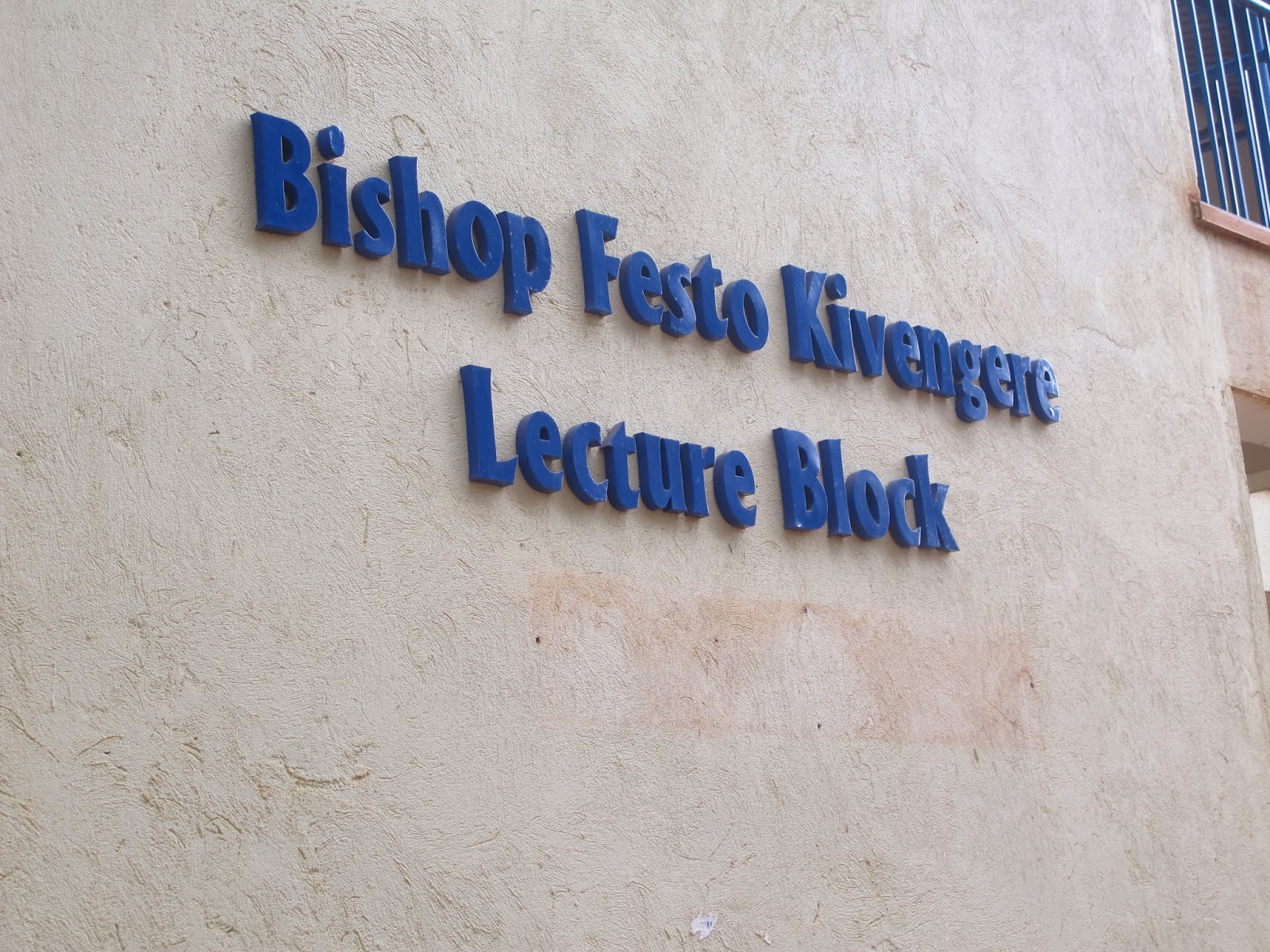
The university buildings are named for important Christian leaders.  Bishop Festo Kivengere was a Christian leader during the time of Idi Amin when many Ugandan Christians were persecuted and killed for their faith.  Kivengere had to flee to Kenya during this period.
Many faculty members are priests (Dr. Medard Rugyendo on the right is Dean of the School of Education and the Arts).
The dedication on the building of the Hamu Mukasa Library.